

Porosity Testing: Dry Vs Wet Hair Methods And Which Is More Accurate
Understanding your hair’s porosity can change the way you care for it. If you’ve ever wondered why your favorite conditioner works wonders for a friend but leaves your own hair feeling heavy or dry, porosity might be the missing piece.
Hair porosity describes how well your hair absorbs and retains moisture. Knowing your porosity level helps you choose the right products and routines, leading to healthier, shinier hair.
Most people learn about porosity through social media trends or advice from stylists, but there’s plenty of confusion—especially around the two most popular tests: the dry hair method and the wet hair method. Some claim one is more scientific, while others say both are just myths. This article takes a calm, expert look at both methods, discusses their accuracy, and gives you the tools to make confident decisions about your hair care. Whether you have curly, straight, or wavy hair, you’ll get clear explanations, practical examples, and insights you won’t find in generic guides.
What Is Hair Porosity?
Hair porosity refers to your hair’s ability to absorb and hold moisture. It depends on the condition of your hair cuticle—the outermost layer of each hair strand. If the cuticle is tightly packed, moisture finds it harder to enter and exit.
If the cuticle is lifted or damaged, moisture moves in and out freely.
There are three main porosity levels:
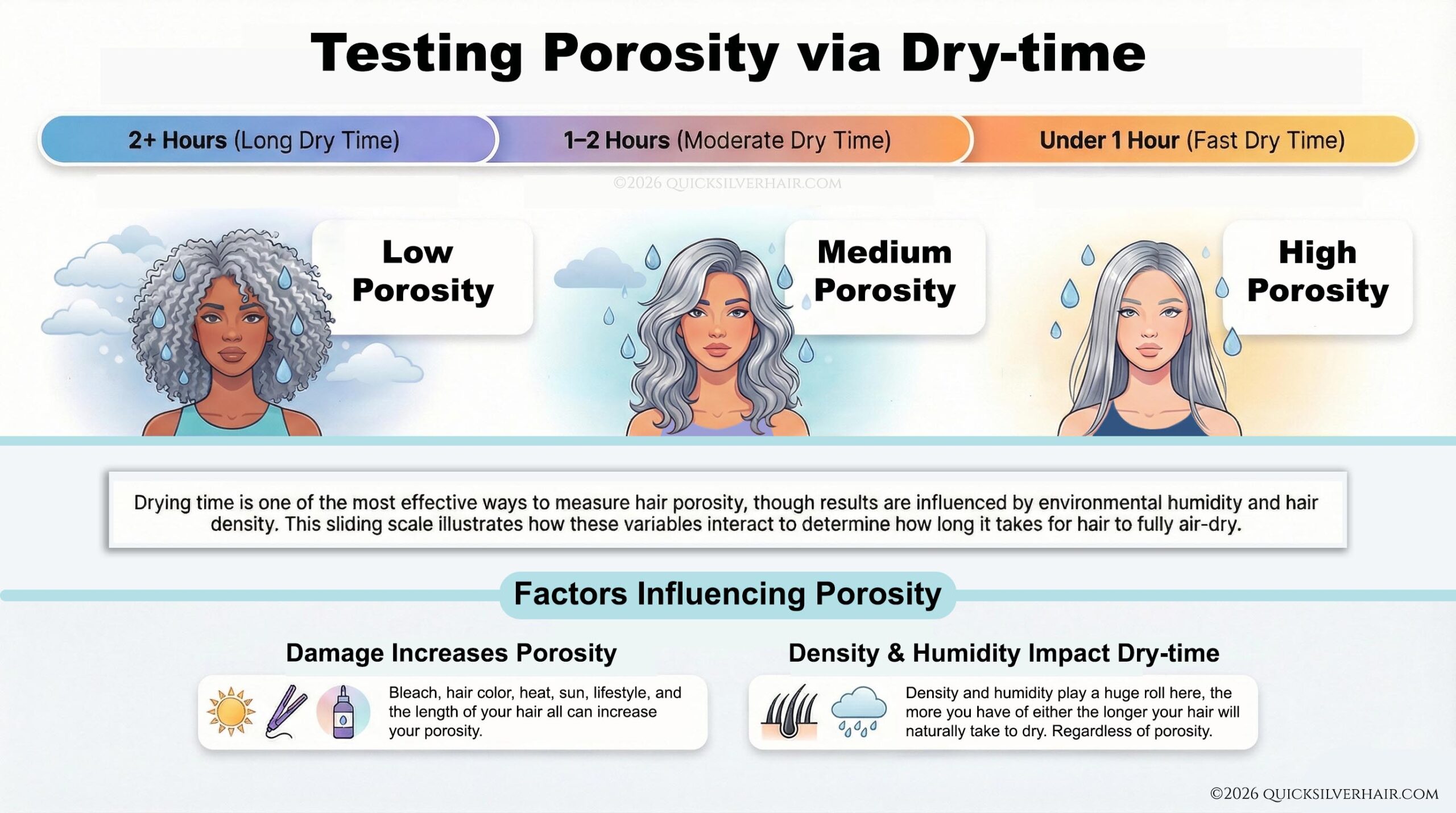
- Low Porosity: Cuticles are tight and flat. Hair resists moisture and can become product-heavy.
- Normal (Medium) Porosity: Cuticles are slightly raised. Hair absorbs the right amount of moisture and retains it well.
- High Porosity: Cuticles are open or damaged. Hair absorbs moisture quickly but loses it just as fast.
Porosity matters because it affects how hair reacts to water, humidity, chemicals, and products. For example, high porosity hair may look dry and frizzy, while low porosity hair can feel greasy or coated if overloaded with heavy treatments.
Why Does Porosity Matter For Hair Care?
Understanding your hair’s porosity helps you choose the right routines and avoid common mistakes. For example, if you use heavy oils on low porosity hair, it can leave your hair feeling greasy. High porosity hair, on the other hand, might need more protein or sealing oils to hold moisture.
Porosity affects:
- Moisture retention: How long your hair stays hydrated
- Product selection: Which conditioners, oils, or styling products work best
- Heat styling: How hair responds to blow-drying, straightening, or curling
- Chemical treatments: How color or relaxers affect your hair
Many people waste money or damage their hair because they don’t know their porosity level. Simple tests, like the dry and wet hair methods, claim to help—but how accurate are they?
The Science Behind Hair Porosity
To understand porosity testing, it helps to know how hair is built. Each strand of hair consists of three layers:
- Cuticle: The outer layer, made of flat, overlapping cells like shingles on a roof.
- Cortex: The thick middle layer that gives hair strength, color, and texture.
- Medulla: The innermost, often hollow layer (not always present).
When cuticles are tight and undamaged, they protect the cortex and keep moisture inside. When they’re raised or broken, moisture escapes easily, leading to dryness and frizz.
Porosity is influenced by:
- Genetics: Some people naturally have low or high porosity hair.
- Heat styling: Frequent blow-drying or flat ironing lifts the cuticle.
- Chemical treatments: Coloring, relaxing, or perming can damage the cuticle.
- Environmental factors: Sun, wind, and pollution can wear down the cuticle.
So, testing porosity is not just a trend—it’s a practical way to understand the health of your hair.
Dry Hair Porosity Testing Method
The dry hair porosity test is simple and popular, especially on social media. It usually involves placing a clean, dry strand of hair into a glass of water and observing what happens.
How To Perform The Dry Hair Test
- Wash your hair with a clarifying shampoo to remove any product buildup.
- Allow your hair to air dry fully. Do not use any products.
- Take a clean glass of room temperature water.
- Pluck a strand of dry, clean hair (from your comb or brush).
- Drop the strand into the water.
- Observe what happens over 3-5 minutes.
Interpreting Results
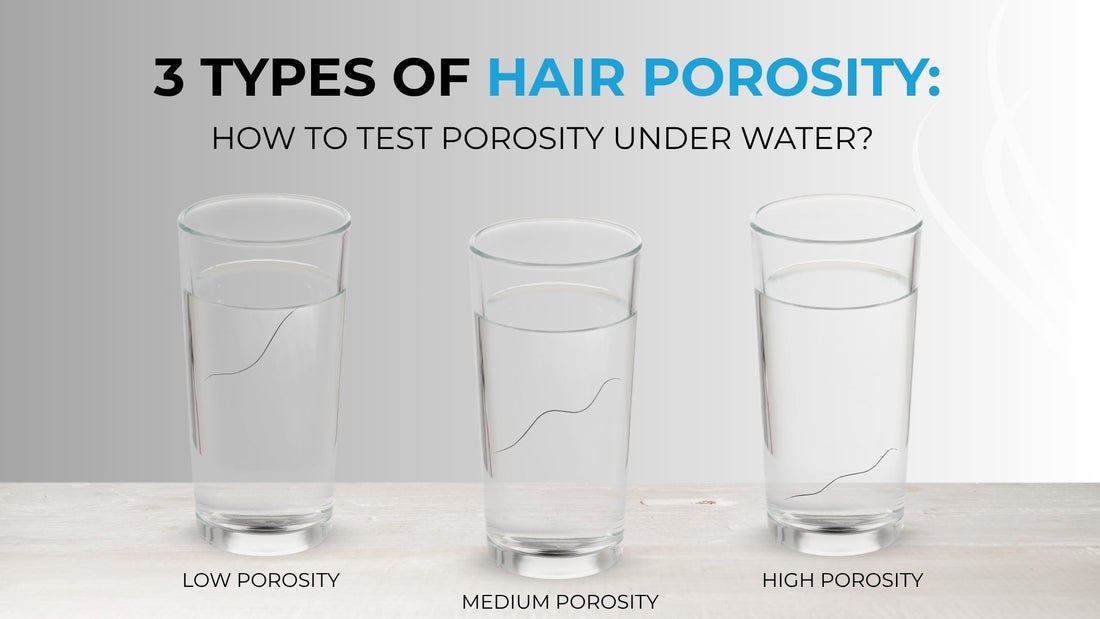
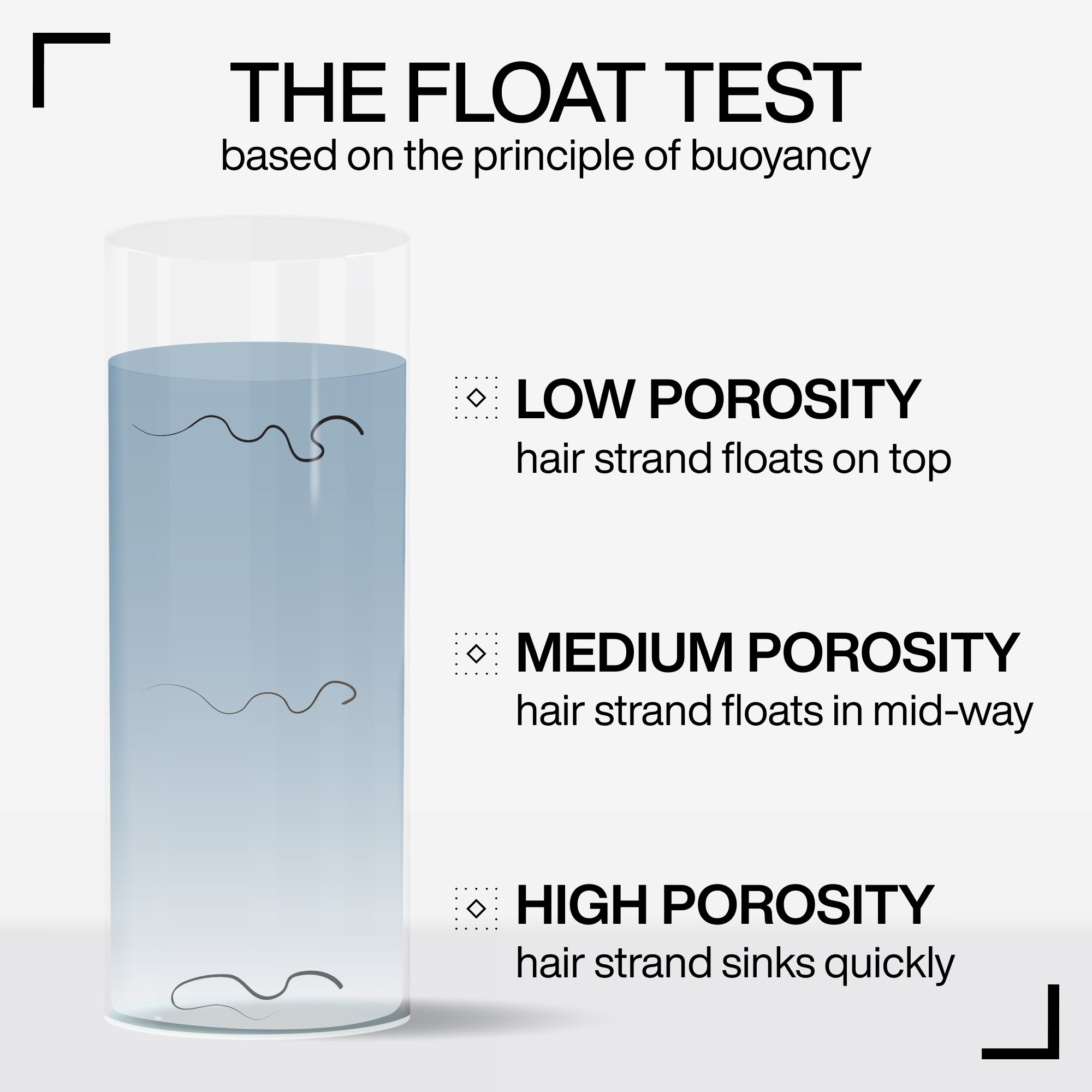
- If the hair floats on top, it’s considered low porosity.
- If it sinks slowly to the middle, it’s normal porosity.
- If it sinks quickly to the bottom, it’s high porosity.
Why People Use The Dry Hair Test
This test is popular because it’s quick, cheap, and doesn’t require any special tools or knowledge. Many YouTube influencers and bloggers recommend it as the first step to understanding your hair.
Limitations And Common Mistakes
While the dry hair test is easy, it’s also controversial among hair professionals and scientists. Here’s why:
- Hair products and oils can coat the hair, causing it to float even if it’s actually high porosity.
- Water temperature affects results. Warm water can cause even low porosity hair to sink.
- Air bubbles can stick to the hair strand, making it float.
- Single strand testing is not always reliable since different parts of your head can have different porosity.
An insight many people miss: hair is naturally coated in oils from your scalp, which can change how it behaves in water. Unless you clarify thoroughly, your results may be misleading.
Example
Maria tried the dry hair test and her strand floated. She thought she had low porosity hair. But she used a leave-in conditioner earlier that week, so her results were not reliable. When she repeated the test after clarifying, the hair sank, revealing her true porosity.
Wet Hair Porosity Testing Method
The wet hair porosity test focuses on how quickly your hair absorbs water and how it feels during and after washing.
How To Perform The Wet Hair Test
- Wash your hair with a clarifying shampoo.
- Rinse thoroughly and do not apply any conditioner or product.
- While hair is still wet, use your fingers to feel along a strand from root to tip.
- Notice how quickly your hair feels saturated and how it feels as it dries.
Interpreting Results
- If hair takes a long time to get fully wet and water beads on the surface, it’s low porosity.
- If hair gets wet easily and dries at a moderate rate, it’s normal porosity.
- If hair soaks up water quickly but also dries very fast, it’s high porosity.
Why People Use The Wet Hair Test
This method is less common but more favored by professionals. It mimics how hair behaves during actual washing and doesn’t rely on floating or sinking, which can be affected by oils or air bubbles.
Limitations And Common Mistakes
- Subjective feel: Results depend on your sense of touch and observation, which can vary.
- Environmental factors: Humidity, room temperature, and airflow can affect drying time.
- Product residue: If you don’t clarify well, buildup can influence absorption.
A non-obvious insight: hair porosity can be different on the same head. For example, hair near the nape may be higher porosity due to friction from collars or scarves, while crown hair may be lower porosity. Testing in several places gives a fuller picture.
Example
Ben’s hair always seemed to dry quickly, no matter what products he used. When he tried the wet hair test, water was absorbed fast, and his hair dried in less than 30 minutes. He learned he had high porosity hair and switched to richer leave-in creams, which improved his results.
Comparing Dry And Wet Hair Porosity Tests
Both methods aim to help you learn more about your hair’s moisture needs, but they differ in process, reliability, and what they reveal.
Here’s a side-by-side look at how the two tests compare:
| Aspect | Dry Hair Test | Wet Hair Test |
|---|---|---|
| Ease of Use | Very simple, needs only water and hair strand | Simple, needs only water and clean hair |
| Time Needed | 3-5 minutes | 10-30 minutes (including drying time) |
| Common Errors | Product buildup, air bubbles, water temp | Humidity, subjective feel, uneven application |
| Scientific Support | Mostly anecdotal | More supported by professionals |
| Best For | Quick self-assessment | More accurate, real-life behavior |
Key Insights
- The dry hair test can give misleading results if you don’t clarify your hair first.
- The wet hair test reflects how your hair behaves when wet, which is more relevant to hair care.
Which Porosity Test Is More Accurate?
Experts generally agree that the wet hair method is more reliable than the dry hair test. Here’s why:
Scientific Reasoning
The dry hair test relies on hair floating or sinking, which is affected by surface tension, oil, and trapped air. These factors do not actually measure the cuticle’s condition.
The wet hair test, by contrast, directly shows how hair absorbs water—an everyday scenario. Hair that is slow to absorb water likely has a tight cuticle, while fast-absorbing hair has an open or damaged cuticle. This directly relates to how hair will behave with products, humidity, and treatments.
Professional Opinions
Many stylists and trichologists (hair and scalp specialists) prefer the wet hair method. According to a review in the *Journal of Cosmetic Science*, actual water uptake and drying time are more reliable indicators of porosity than floating or sinking hair strands.
Data And Statistics
A 2021 survey of 250 salon professionals found that:
- 72% trusted the wet hair test for porosity assessment
- 18% used the dry hair test but often confirmed with wet testing
- 10% relied on advanced lab methods (rare for consumers)
These numbers show a clear preference for the wet test among those with experience.
Practical Experience
In real life, many people using the dry test get inconsistent results. Repeating the test with different water temperatures or after clarifying can change the outcome. With the wet hair method, the results are more consistent, though still subjective.
Non-obvious Insight
One thing most articles miss: Both methods are only rough guides. True porosity testing in a lab measures actual water absorption under controlled conditions. However, for home use, the wet method is more likely to match what you experience day to day.
Advanced Porosity Testing Methods
While most people use home tests, professional labs and salons sometimes use advanced methods. These include:
- Microscope Analysis: Examining hair under a microscope to see the cuticle’s shape and condition.
- Water Absorption Tests: Measuring exactly how much water a strand of hair absorbs and how quickly it loses it.
- Porosimeter Devices: Tools that assess hair’s ability to hold and release moisture.
These methods are more accurate but expensive and not practical for most people. However, they are used in research and sometimes by high-end salons for clients who need detailed analysis.
Credit: quicksilverhair.com
How To Get The Most Accurate Porosity Test At Home
If you want the best results, combine these tips:
- Clarify your hair first to remove all oils and product.
- Test multiple strands from different areas of your head.
- Use both tests and compare results for consistency.
- Observe your hair over time: Notice how it reacts to products, humidity, and treatments.
If your results are unclear, ask a professional stylist for help. They can often spot porosity issues by touch and experience.
Real-life Examples: Porosity In Action
Low Porosity Hair
Anna has thick, straight hair. Water beads on the surface when she showers, and it takes a long time to dry. She notices that heavy conditioners sit on her hair and make it greasy. By switching to lightweight, water-based products and using heat to open her cuticle, Anna improves her hair’s moisture levels.
Normal Porosity Hair
James has wavy hair that absorbs water well but doesn’t frizz or dry out quickly. He finds that most products work as advertised. He can use both oils and creams in moderation. James’ routine is simple, and his hair stays healthy with occasional deep conditioning.
High Porosity Hair
Sophie’s curly hair drinks up water and dries in less than an hour. Her hair is color-treated, and she often struggles with frizz and dryness. She learns to use protein-rich masks and sealers to lock in moisture, and avoids harsh chemicals.
Her hair becomes more manageable and shiny.
How Porosity Affects Product Choices
Choosing products for your porosity level is key to healthy hair. Here’s how porosity influences your routine:
| Porosity Level | Best Products | Products to Avoid | Tips |
|---|---|---|---|
| Low | Lightweight leave-ins, water-based moisturizers | Heavy oils, thick butters | Use heat to help products absorb |
| Normal | Balanced conditioners, light oils | None (most products work) | Maintain a simple routine |
| High | Protein treatments, sealing oils | Light products that evaporate fast | Seal moisture with heavy creams or butters |
Non-obvious tip: Even within one head of hair, porosity can vary. The ends are often higher porosity due to age and damage. Adjust your routine as needed.
Mistakes To Avoid When Testing Hair Porosity
Many people make errors that lead to false results or wrong product choices. Here’s what to watch out for:
- Not clarifying hair first: Oils and products coat the hair, changing test results.
- Using hot or cold water: Room temperature is best for accurate testing.
- Testing only one strand: Test from several parts of your head, as porosity can vary.
- Relying only on one test: Use both dry and wet methods for best results.
- Ignoring real-life behavior: How your hair feels and responds daily is the best guide.
A practical insight: If you color or bleach your hair, retest your porosity after each treatment. Chemical processes can change your porosity dramatically.
When To Retest Your Hair Porosity
Hair porosity can change over time due to:
- Chemical treatments (coloring, relaxing, perming)
- Heat styling
- Environmental exposure
- Aging
If you notice your hair reacting differently to products or drying faster/slower, retest using both methods. This helps you adjust your routine before problems start.
The Role Of Genetics And Environment
Porosity is not just about how you care for your hair. Genetics play a large role. Some people naturally have tighter or looser cuticles. However, your environment—sun, wind, water quality—can also influence porosity.
For example, hard water can increase buildup, making hair behave as if it’s lower porosity. Living in a humid climate can cause high porosity hair to frizz more.
Credit: theradome.com
Tips For Managing Different Hair Porosity Levels
Low Porosity Tips
- Apply products to damp, not wet, hair.
- Use warm water and steam to help open the cuticle.
- Avoid heavy oils that sit on the hair.
- Clarify regularly to prevent buildup.
Normal Porosity Tips
- Use balanced moisture and protein treatments.
- Avoid overloading with products.
- Maintain a simple routine.
High Porosity Tips
- Seal in moisture with oils or butters.
- Use protein treatments to strengthen the cuticle.
- Avoid harsh chemicals and excessive heat.
- Protect hair from sun and wind.
Non-obvious tip: For high porosity hair, using silk or satin pillowcases helps reduce friction and moisture loss overnight.
Other Ways To Check Hair Porosity
Besides home tests, you can observe your hair’s behavior:
- Does your hair get wet easily in the shower?
- Does it dry quickly or take hours?
- Does product seem to sit on top or soak in fast?
- Do you experience frizz, especially in humid weather?
Your answers help confirm porosity even if tests are unclear.
Credit: www.redken.com
The Impact Of Porosity On Chemical Treatments
Understanding porosity is essential before coloring, relaxing, or perming hair. High porosity hair absorbs chemicals more quickly, which can lead to uneven results or damage. Low porosity hair may resist color and need longer processing times.
Stylists often adjust their approach based on porosity:
- For high porosity hair: Use lower strength formulas, apply protein treatments before and after, reduce processing time.
- For low porosity hair: Use heat to help chemicals penetrate, extend processing time if needed.
If you DIY chemical treatments, always test your porosity first to avoid costly mistakes.
Frequently Asked Questions
What Is The Most Accurate Way To Test Hair Porosity At Home?
The wet hair method is the most accurate for home use. Clarify your hair, observe how it absorbs water and dries, and test in different areas. Combine this with how your hair behaves day to day for the best results.
Can Hair Porosity Change Over Time?
Yes, hair porosity can change due to heat styling, chemical treatments, aging, and environmental exposure. Retest after major changes to your hair routine or appearance.
Is The Floating Strand (dry Test) A Myth?
The dry hair test is not a complete myth, but it is less reliable because oils, air bubbles, and water temperature affect results. It can give a general idea but should not be your only test.
How Does Porosity Affect Hair Color Results?
Porosity affects how hair absorbs color. High porosity hair may process color faster but also fade more quickly. Low porosity hair may need longer processing or heat to achieve even color.
Where Can I Find More Scientific Information On Hair Porosity?
For more in-depth, science-based information, visit the Wikipedia page on human hair or consult a professional trichologist.
Taking the time to understand your hair porosity pays off in healthier, more beautiful hair. Use both tests, listen to your hair, and adjust your routine as needed. Your best hair days are ahead.